

Written by Shea Henderson
Published March 17, 2025
As global powers become increasingly reliant on advanced technology to drive economic growth and maintain military power, the US has adopted a protectionist stance towards China focused on national security. This approach began during the Trump administration with semiconductor export controls and later evolved under Biden into the formalized “small yard, high fence” policy. Initially aimed to safeguard a subset of critical technology through strict trade controls, it has since broadened into a more aggressive effort to limit China’s development of advanced technology and maintain US dominance in AI, integrated circuits (ICs), and quantum computing.
The US policies have fueled an ongoing US-China technology trade war, which—likely to intensify under a new Trump presidency—resembles Cold War-era containment strategies, where national security concerns outweigh economic globalization. The conflict has led to fragmented supply chains, shifting alliances, and heightened market uncertainty regarding the future of technology. This uncertainty was evident in January 2025, when Chinese startup DeepSeek’s r1 model release triggered the largest single-day decline ever of a publicly traded company. As global technology advancements accelerate, uncertainty surrounding the origins and control of these capabilities will persist, further exacerbating trade tensions.
Amid rising concerns over China’s push for technological dominance and self-sufficiency, the Biden administration tightened export controls in the final months of its term. On December 2, 2024, it introduced a new set of semiconductor restrictions, building upon previous measures from 2022, 2023, and April 2024. These regulations further restrict China’s ability to indigenize advanced semiconductor production by limiting access to cutting-edge AI chips, semiconductor manufacturing equipment (SME), and critical software tools. Key measures include tighter controls on high-end chips, particularly advanced logic and high-bandwidth memory (HBM) chips, which are essential for AI and supercomputing. Additionally, SME restrictions were expanded alongside tighter controls on the software required to design and produce advanced-node integrated circuits.
A critical aspect of these controls is the expansion of the Foreign Direct Product Rule (FDP Rule), which tightens the de minimis rule and closes loopholes that previously allowed China to indirectly access restricted technologies. This new rule subjects foreign-made SMEs to US export restrictions if they contain US-origin technology or equipment. Moreover, the US Entity List was expanded to include 140 new companies identified as supporting Beijing’s technology ambitions, with those firms designated under Footnote 5 to broaden the FDP Rule to cover Entity List countries. This adds another layer of complexity to export controls, forcing companies to carefully assess their customers and end-users.
On January 13, 2025, the US Department of Commerce’s Bureau of Industry and Security (BIS) introduced a second set of regulations: the Export Control Framework for Artificial Intelligence Diffusion. This policy aims to control the global spread of advanced AI models and large-scale clusters of advanced computing ICs. It introduces a three-tier licensing framework for access to advanced AI chips: Tier 1 allies—such as Japan, South Korea, and Taiwan—enjoy largely unrestricted access, while Tier 2 countries face quotas, and Tier 3 adversaries are completely blocked. New due diligence requirements mandate that semiconductor foundries and packaging firms report compliance measures, while additional restrictions on AI model weights aim to limit the development of proprietary AI systems overseas that exceed a specific computational threshold.
Nowhere will these ripple effects be more pronounced than in East and Southeast Asia, home to the world’s most critical semiconductor and IC supply chains. As the technology race accelerates, countries in the region will need to navigate the competing pressures of US security policies, their economic interdependence with China, and their own strategic interests—forcing them to make difficult decisions in balancing diplomacy, economic resilience, and technological sovereignty.
East and Southeast Asia remain indispensable to the global semiconductor supply chain, with Taiwan at its core. Over the past four decades, Taiwan has cultivated a world-leading semiconductor ecosystem, integrating chip design, manufacturing, packaging, and testing. By pioneering the “pure-play foundry” model through TSMC, Taiwan has positioned itself as a global leader in semiconductor production, accounting for approximately 60% of global foundry production and more than 90% of the world’s most advanced chips (5nm and below). The sector contributes roughly 15% of Taiwan’s GDP and represents over 40% of its total exports, reinforcing both its economic resilience and geopolitical significance. This dominance underpins Taiwan’s so-called “Silicon Shield,” as any disruption to its semiconductor industry would send shockwaves through global markets, serving as a deterrent to potential military conflict. However, the recent US semiconductor policies aimed at curbing China’s technological rise are now directly reshaping Taiwan’s role in the global supply chain, posing both economic and strategic risks.

Photo: Bloomberg | Getty Images
Taiwanese semiconductor firms are being forced into rigorous due diligence and compliance processes while barring them from selling to many previously large customers in China. With over 50% of Taiwan’s semiconductor exports directed toward China, the blacklisting of firms like Huawei and SMIC, which had previously been major customers of Taiwanese firms, significantly reduces market opportunities for companies like TSMC and UMC. Additionally, these firms are constrained in selling high-end technology products to Chinese companies, impacting their growth in the world’s largest semiconductor consumer market. As demand shifts, Taiwanese foundries may face excess capacity for certain advanced nodes that were once tailored for Chinese clients, while their ability to backfill lost orders with US and allied markets remains uncertain due to geopolitical complexities and supply chain restructuring. The long-term effect may be a slowdown in Taiwan’s semiconductor revenue growth and gradual loss of influence over the global supply chain, particularly if China accelerates efforts to develop domestic solutions or shifts to international suppliers willing to bypass US restrictions.
At the same time, the US is aggressively promoting “onshoring” and “nearshoring” strategies to reduce dependence on Taiwan for semiconductor production. By using subsidies and the hopes of greater diplomatic alliances, the US has compelled Taiwanese firms to expand their global production footprint. While this enhances US and allied supply chain security, it also presents serious challenges for Taiwan through higher production costs, the erosion of its local semiconductor ecosystem, and the loss of economic leverage with China. By relocating production to the US, Japan, or Europe, Taiwanese firms face larger capital expenditure and operational costs, TSMC founder Morris Chang has even stated that manufacturing in the US is “50% more expensive”. It also hollows out Taiwan’s domestic semiconductor supply chain, reducing crucial vertical integration and weakening its global competitiveness over time. Additionally, these moves diminish Taiwan’s strategic bargaining power as a reduction in chip sales to China reduces one of Taiwan’s key economic levers. These policies come at a time when China is rapidly accelerating its domestic semiconductor self-sufficiency efforts through initiatives like the Made in China 2025 plan and its $143 billion semiconductor fund.
Taiwan is not alone in facing the effects of US policies, as Japan and South Korea—along with Taiwan—account for over 90% of global semiconductor production and now face increasing uncertainty. The globalization of chipmaking has led each region to carve out its comparative advantage, driving down costs and fostering innovation. Taiwan specializes in chip fabrication, South Korea dominates memory chip production, controlling two-thirds of the market, and Japan holds a 30% share of the global SME market while maintaining a near-monopoly on key materials, chemicals, and gases. Like Taiwan, South Korea and Japan have significant market exposure to China and now face increasing pressure to reduce dependence on Chinese revenue. Currently, over 50% of South Korea’s domestically produced ICs are exported to China, and more than 30% of Japan’s SME exports are China-bound.
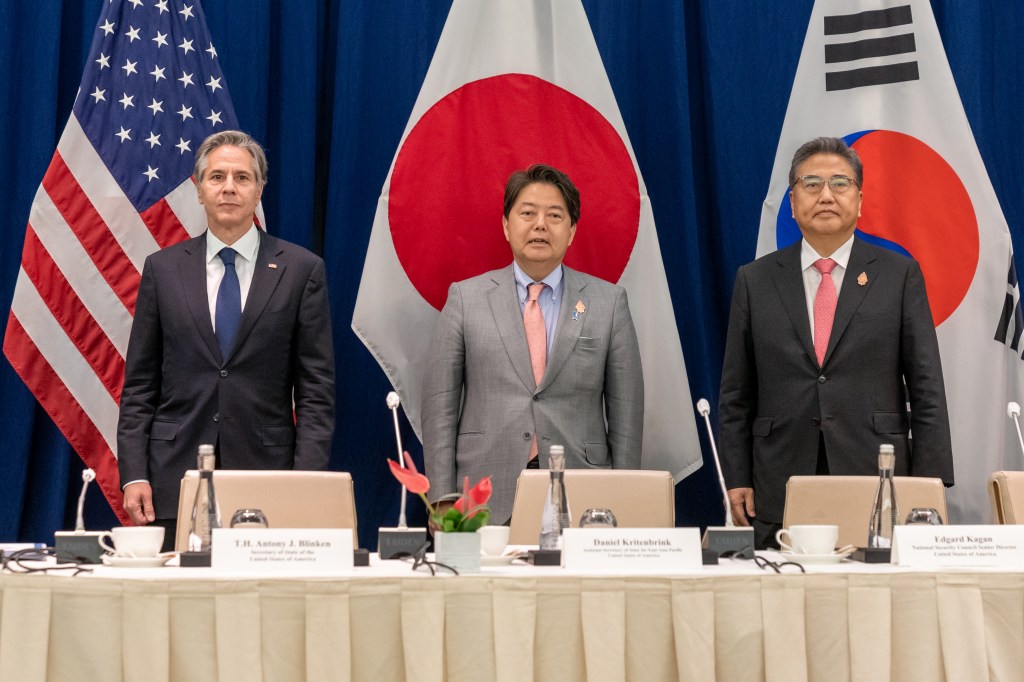
Photo: U.S. Department of State
In response, Japan has aligned more closely with US policies, introducing key export licensing requirements and working with the Netherlands and the US to restrict China’s access to advanced SMEs. It has also joined the Chip 4 Alliance, a US-led initiative aimed at strengthening the alliance between the US, Taiwan, Japan, and South Korea. These changes have caused more Japanese multinational companies to exit China, leading to greater financial difficulties among firms with Chinese revenue, and compliance issues related to the complex sweeping nature of US controls. Japan will also have to factor in retaliatory actions from China, as private firms such as Toyota have already voiced their fear over possible restrictions on access to rare earth minerals.
South Korea, however, has taken a more cautious approach. While it has participated in Chip 4 discussions, it has not fully committed to US policies due to its deep economic ties with China. Its two largest chipmakers, Samsung Electronics and SK Hynix, have sought to maintain operations in China. However, the waivers they obtained to do so are only temporary. With over 60% of South Korean chip exports directed to China, and legacy chip fabs like that of Samsung’s in Xi’an contributing over 40% of its NAND production, it will be very difficult for South Korea to quickly decouple. Taiwan and Japan should look to South Korea as a prudent example of focusing on domestic health relative to geopolitical considerations, as the three countries face impending economic shifts.
While US regulations aim to preserve the global technological status quo, it is crucial to consider the economic implications and unintended consequences of these policies. US firms have voiced concerns over the potential harm, with Nvidia CEO Jensen Huang warning that restricting access to key technologies will only accelerate China’s efforts to develop domestic supply chains. Rather than relying on government outreach, the US should focus on winning through innovation and competition. At a minimum, policymakers should tailor regulations to align with industry needs, fostering an environment that encourages technological progress while mitigating the risk of ceding ground to Chinese firms. Ultimately, the US must recognize that China has long prioritized building domestic supply chains, and overly restrictive policies may inadvertently fast-track its path to technological self-sufficiency.
Taiwan, South Korea, Japan, and the broader Southeast Asian region will need to reduce their reliance on China for advanced technology sales and diversify their sales channels to mitigate geopolitical and supply chain risks. By gradually expanding into alternative markets—while balancing revenue stability and R&D expenditures—these nations can strengthen trade relationships with other economies and safeguard their market shares. At the same time, their governments should actively support domestic semiconductor, SME, and advanced technology industries by targeting subsidies, tax incentives, and investment in advanced manufacturing. Strengthening domestic production capabilities not only enhances economic resilience but also aligns with shifting global trade dynamics, where companies are increasingly factoring geopolitics into long-term strategies. Additionally, fostering regional partnerships—such as supply chain collaborations through frameworks like the Indo-Pacific Economic Framework (IPEF) and deepening ties with the EU and the US—could further reduce overdependence on China while ensuring sustainable technological growth.
 Taiwan Center for Security Studies