
TCSS Security Commentaries #041
Maximilian Förstel, TCSS Intern
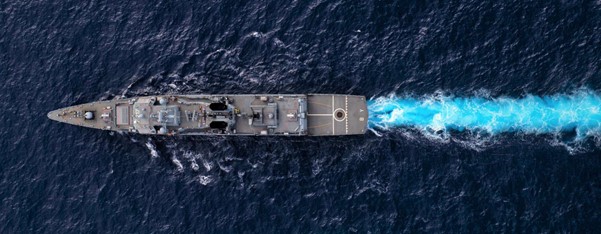
Source : https://www.bundeswehr.de/de/organisation/marine/aktuelles/indo-pacific-deployment-2021
On May 7th, the German Navy embarked on its long-planned 2024 Indo-pacific deployment (IPD 24). Two vessels, the F125-class frigate Baden-Württemberg and the Berlin-class replenishment ship Frankfurt am Main, departed for the Indo-pacific in what has been described as the most complex and ambitious German deployment ever undertaken in the region.
Politically, IPD 24 falls in a time of heigh political focus on both the military realm and the importance of the Indo-Pacific in German politics. The Russian Invasion of Ukraine has prompted the German Government to initiate the Zeitenwende, an initiative to modernize the German military and improve its combat readiness. Furthermore, IPD 24 is under the auspices of both the German 2023 China Strategy and 2021 Indo-pacific guidelines. Former describes the increasing importance of the Indo-pacific region for European and German interests, emphasizing Germany’s intent to increase its political and military cooperation in the region. It further notes that China is increasingly challenging principles of international law, the upholding of which has been described as one of the core tasks of IPD 24.
The 6 month deployment will see the German ships exercise with the US and Canadian Navies in the Atlantic before transiting the Panama Canal in early June. The detachment will then take part in exercises around Hawaii, notably involving RIMPAC. During this time, 30 aircrafts from the German Airforce will form the second part of IPD 24, embarking on a round-the world trip alongside 20 aircraft from France and Spain. This force will be meeting the naval formation at RIMPAC before proceeding to additional exercises in India, while Baden-Württemberg and Frankfurt am Main will continue to Japan.
The 2021 deployment, the South China Sea and the Taiwan Strait
The IPD 24 follows the 2021 deployment of the F123 class frigate Bayern to the region, which was then the first German warship in 20 years to transit the South China Sea (SCS). At the time, a planned formal visit to Shanghai was denied by the Chinese Government and the Frigate did not transit the Taiwan strait, instead choosing a detour around the east of the island. While the Bayern did transit the South China Sea, it stayed in international shipping routes and did not engage in any form of military drills. Thus, Bayern did not directly challenge the PRC’s territorial claims in the South China Sea, as warships of foreign countries have a right to innocent passage in territorial waters, which implies using the shortest available route and refraining from military drills.
With this background in mind, one of the main points of contention has been the exact routing of this year’s detachment, as any transit of the Taiwan Strait would likely anger China, Germany’s second-largest trading partner. The next scheduled port call after Tokyo will be Singapore, the direct route to which would take the detachment through the Taiwan Strait. As of this month, no decision has been made, although Defence Minister Pistorius stated on May 7th that a transit of the strait is under consideration. Allegedly, the German Ministry of Defence (MoD) has been advocating such a transit, while the Ministry of Foreign Affairs has been reluctant. The ultimate decision on this issue will be a good indication of the direction Sino-German relations are trending after Chancellor’s Scholz visit to China in April.
After the passage or detour of the Taiwan Strait, the transit through the SCS has already been confirmed. It will be interesting to observe how exactly this transit is going to be conducted in comparison to the 2021 deployment, both in regard to the exact route taken and the conduction of military drills such as helicopter take-offs and landings. Tensions in the SCS have recently risen to new levels, with the Philippines and PRC engaged in frequent stand-offs and occasional water cannon engagements. As recently as April 13th, the Philippines have reported spotting Chinese vessels engaging in low-profile land reclamation efforts at the Sabina Shoal, 60KM east of the Second Thomas Shoal. The Sabina Shoal would, if the Chinese efforts are serious, constitute by far the closest PRC land reclamation effort to the Philippines, as it is located just 130 KM west of Palawan and well within the EEZ of the Philippines. In light of these developments, a simple “innocent passage” by the German vessels might be considered as falling short of the stated goal of the trip to uphold international law.
The limits and future of German Naval Power
While the F125 class has the endurance for a long and political deployment like the IPD 24, it also shows the limitations Germany faces when it comes to deploying actual combat power to the region. The F125 class has been designed for low-intensity operations and endurance and therefore fits both the lengthy and political nature of the trip. But this design philosophy has also led to the class being severely outperformed by warships even half its size – the 7200ton F125 does not have any vertical launch system(VLS) and rather relies on 8 canister-launched harpoon missiles for anti-ship operations. It compares poorly to the smaller surface combatants used by the PRC in the SCS – even the 4000ton 054A frigates sport an impressive 32 VLS cells for both Air Defence and Anti-ship operations. These performance issues could, if combined with a complaisant journey, reinforce the impression that Germany is both reluctant and unable to get actively engaged in the region.
The F125s predecessor, the F124 class, has seen action in the Red Sea during the EU’s operation Aspides, fits 32 VLS cells and was designed for high-intensity operations. But of the 3 ships of the class, the Hessen just returned from Aspides, while Hamburg will take her spot in the Red Sea this summer. The third ship, Sachsen, is undergoing maintenance and will only be available later this year. This obvious shortfall in the number of available platforms has led to the German Navy ordering two additional F126 class frigates on top of the originally planned 4. The F126 is the largest shipbuilding project in the history of the German Navy and will solve the capability issues of the F125, nevertheless the first ship of the class started construction in December 2023 and will only become available by 2028.
Overall, IPD 24 is an important signal of political will regarding Germany’s commitment to the Indo-pacific. While the exact message of the trip will ultimately depend on political decisions in regard to a transit of the Taiwan Strait and exercises in the SCS, the trip also highlights the military challenges Germany is facing when it comes to projecting power in the Indo-Pacific until new capabilities will become available by the end of this decade.
Maximilian Förstel is a 3rd year undergraduate student of International Relations at the University of Erfurt and Intern at the Taiwan Centre for Strategic and International studies.
 Taiwan Center for Security Studies