
August 24th 2023
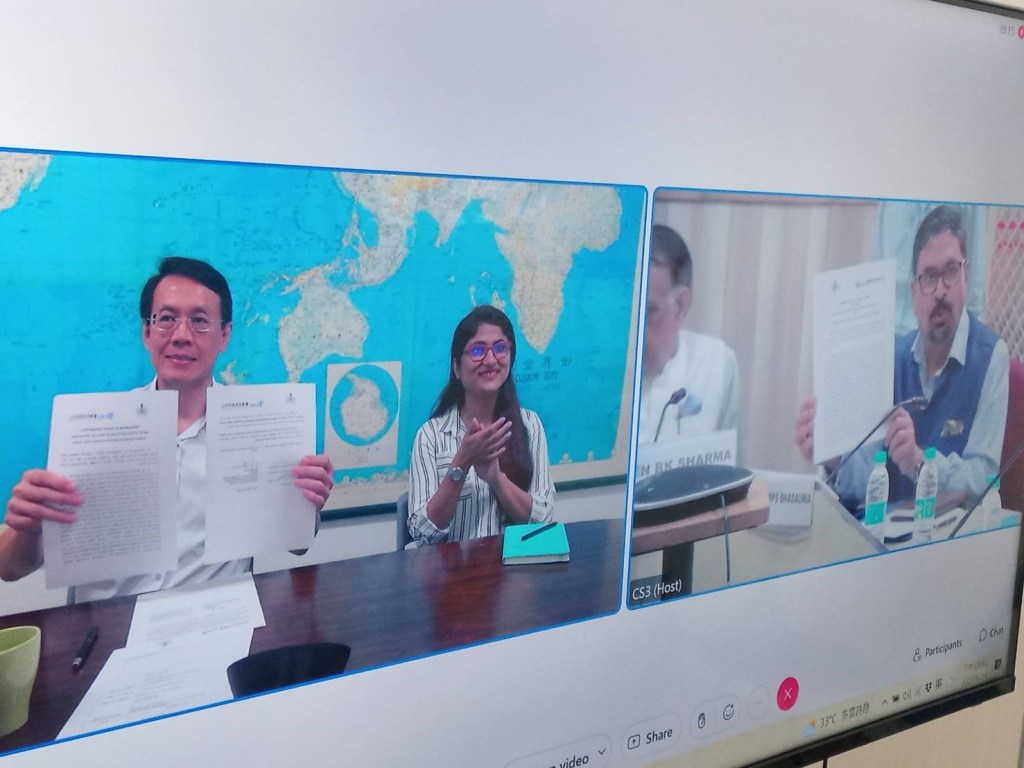
The Taiwan Center of Security Studies (TCSS) is pleased to announce that on August 24 a Memorandum of Understanding (MoU) was signed with the United Service Institution (USI) of India. The event took place via video-conference and was attended by key representatives from both sides.
Founded in 1870, USI of India is India’s preeminent national security and defense think tank. Guided by its commitment to the ‘furtherance of interest and knowledge in the art, science and literature of the defence services’, its 15,000 members – from an array of military and civilian sectors – allow the organisation to possess a wide knowledge base across the full spectrum of fields that concern international politics and security. The institute’s signature journal – the USI Journal – has been published regularly since 1871, making it Asia’s oldest quarterly journal.
TCSS welcomes collaboration with an institution of such prestige. In signing the MoU, both parties agree to involve eminent persons in research and discussions in the fields of international security, international relations, diplomacy, defence and security, military affairs, conflict studies, disruptive technologies, weapons of mass destruction, South Asia, Indo-Pacific, Maritime Security and Maritime heritage. Through this, with a particular, but not limited to, focus on the Indo-Pacific and India-Taiwan-China, an advanced understanding of geopolitics, geo-economics, and strategic security can be developed for various stakeholders as mutually agreed.
At the signing Professor Fu-kuo Liu remarked that ‘the signing of this MoU promotes collaboration and the exchange of views from countries on either side of the Indo-Pacific. This is a significant step in forging a deeper understanding of regional security.’ Also, he said that he ‘looks forward to promoting Taiwan-India cooperation as our interests and values converge in many areas.’
Major General BK Sharma (Retd) commented that the ‘MoU lays the foundation for deeper cooperation between India and Taiwan at a time of unprecedented importance.’ Moreover, he said that, ‘as Indo-Pacific partners, it is incumbent upon us to work together to find best practice solutions.’
 Taiwan Center for Security Studies