
Press Release: October 30th, 2024
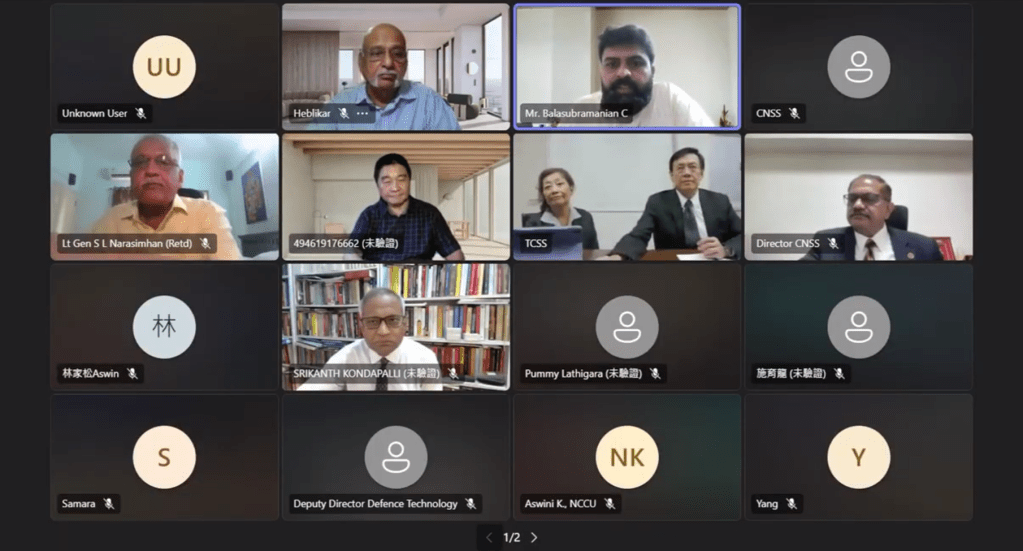
On October 30th, 2024, the Centre for National Security Studies (CNSS) at Ramaiah University in Bangladesh and the Taiwan Center for Security Studies (TCSS) held a joint online forum analyzing Taiwan’s increasingly central role in the security, economy, and politics of the Indo-Pacific.
PM Heblikar, member of CNSS and Emeritus Resource Faculty in the School of International Cooperation (SICSSL) at Rashtriya Raksha University, welcomed the collaboration of this panel as it would bring extraordinary insights into Taiwan’s national importance to India and international relevance to the broader Indo-pacific. Director of TCSS Fu-Kuo Liu similarly expressed his appreciation for the opportunity to learn the perspective of Indian policy analysts and unpack different countries’ concerns in the Indo-Pacific, particularly in relation to China.
The keynote address was then given by Professor Madhav Nalapat, Director of Geopolitics and International Relations and UNESCO Peace Chair at Manipal University. Professor Nalapat emphasized that Taiwan’s spirit of democracy makes it a critical partner for democracies worldwide, especially for India. As global alliances shift due to rising US-China tensions, India no longer regards China as a friend and instead sees Taiwan as a key ally in ensuring Indo-Pacific security, particularly in countering China’s assertive territorial ambitions.
The conference then proceeded to Topic 1: Criticality of Taiwan to the Indo-Pacific Region, where Professor Srikanth Kondapalli, Dean of the School of International Studies at Jawaharlal Nehru University, discussed Taiwan’s strategic importance. Specifically, as the geopolitical focus shifts from the Atlantic to the Pacific, Taiwan is a vital hub for economic growth, tech innovation, and the global semiconductor industry, making it likewise central to the Indo-Pacific’s development. Maj. Gen. Jui-Chou Richard Hu, Deputy Director at TCSS, then highlighted Taiwan’s vital placement in the Sino-U.S. power struggle. Geographically, Taiwan serves as a defense line against China and a chokepoint for East and South China Sea access. And, as a significant non-NATO ally, Taiwan’s fate reflects US global influence. If seized by China, it could destabilize the Indo-Pacific and shift China’s focus to other regional targets.
Topic 2: Unveiling New Directions in Taiwan’s Foreign Policy thereafter commenced with Lieutenant General SL Narasimhan, Emeritus Resource Faculty in SICSSL at Raksha University, who noted that Taiwan’s foreign policy has evolved from a unilateral outreach to more reciprocal, bilateral relations. Current policies focus on economic partnerships, people-to-people connections, and integration into global supply chains especially by strengthening coalitions, pursuing the New Southbound Policy, and enhancing ties in healthcare, biotech, trade, and culture. The following speaker, Dr. Mignonne Chan, Deputy Director at TCSS, concluded the conference by reviewing Taiwan’s complex historical background and its contribution to Taiwan’s current divided sense of identity, effectively showcasing identity’s impact on Taiwan’s foreign policies in relation to China and Taiwanese independence.
Dr. Liu and Major General Prasad concluded the webinar by encouraging more consistent engagement between Indian and Taiwanese institutions, thereby creating a long-term partnership where they are able to work together through volatile situations. As Taiwan-India relations evolve, both foresee alignment and collaboration in the future.
Overall, the forum underscored Taiwan’s strategic significance in the Indo-Pacific and the potential for deeper India-Taiwan collaboration amid shifting global dynamics. With shared democratic values and complementary economic and security interests, both nations will benefit from continued partnership.
 Taiwan Center for Security Studies