
TCSS Security Commentaries #040
Utkarsh Verma, PHD Student at the International Doctoral Program in Asia-Pacific Studies (IDAS), National Chengchi University
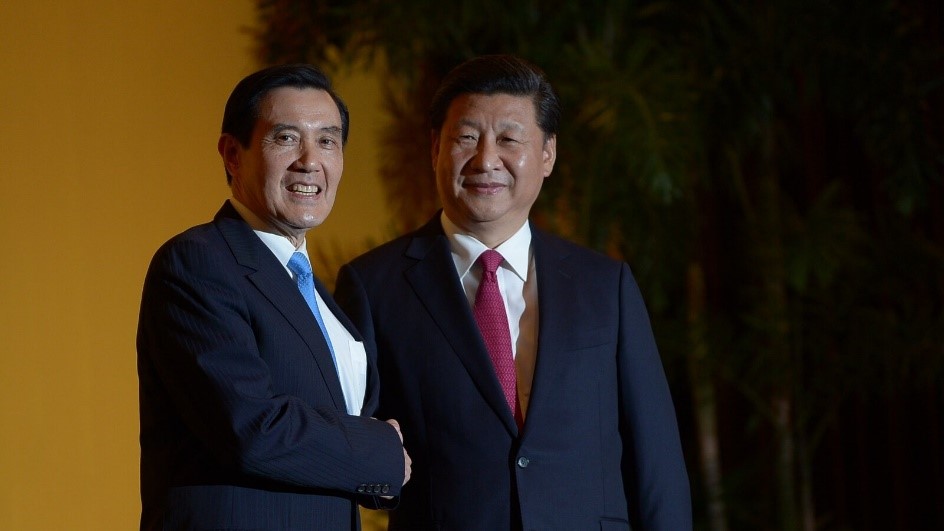
source : https://www.nytimes.com/2023/03/27/world/asia/taiwan-china-ma-visit.html
During his visit to China, Taiwanese former president, Ma Ying-Jeou met PRC President Xi Jinping at Beijing’s People’s Great Hall. In the opening remarks Mr Xi referred to Mr. Ma as a ‘patriot’ who has always supported peaceful development across the Taiwan Strait. Even though Mr. Ma has long not been in power, he still ‘sat at a long table like two statesman entering negotiations’, reported the New York Times. Xi also pressed on the ‘one-China principle’ by saying, “The difference in systems does not alter the objective fact that the two sides of the strait are of one country and one nation.” Both sides concur with the view that ‘war would be unbearable’ and ‘There is no problem that cannot be talked through’. These events unfolded when Mr. Ma became the only former president from Taiwan to visit the mainland while leading a delegation of eleven Taiwanese students to the People’s Republic.
It is important to note that no Taiwanese president in their official capacity has ever visited China. The visit majorly focused on easing the raging tensions across the Taiwan Strait. Ma Ying-Jeou is the leader of the largest opposition party in Taiwan, the Nationalist Party or the Kuomintang (KMT) (zhongguoguomindang 中國國民黨) who acted as the president of Taiwan from 2011-2016 and has been playing a key role in the KMT. The timing of the visit coincides with the rising tensions in the Taiwan Strait. Mr. Ma acts as an unofficial representative from the Republic of China continuously trying to engage with the PRC. After becoming the President of the People’s Republic, Xi Jinping has been especially aggressive towards its neighbors indicating that the period of ‘biding one’s time’ has already been exhausted.
Over the past few years, Xi has aggravated his claim on Taiwan as a Chinese province and even vowed to annex it through military means if necessary. Xi has showcased to the world that he is serious about this through the display of economic, political, and nearly daily military intimidation techniques to pressure Taiwan into accepting his dictation of Chinese rule. Therefore a visit from Mr. Ma to the mainland becomes significant as an attempt to relieve the already strained relations with Taiwan. But the important question here is ‘Why would a former president lead a student delegation to the mainland to ease tensions between the two nations? The answer to this question highlights the historical political disagreement in the Taiwan political spectrum. The KMT has traditionally been more amicable towards the mainland and fairly agrees with the concept of the ‘one nation’ two states formula. In contrast, the democratic people’s Party (DPP) Minzhu Jinbudang (民主進步黨) is fighting for Taiwanese identity and a different nation for its people.
With the intention of utilizing Taiwan as a temporary base for an invasion of the mainland and retaking it from the communists, Chiang Kai Shek, his bureaucracy, and almost a million Chinese civilians went to the Island after the Chinese civil war in 1949. As a result, historically, the KMT believed that Taiwan’s populace was Chinese at heart and blood; in contrast, the DPP, which was founded in 1986, believes that Taiwanese identity is distinct from Chinese ancestry. However, after eight years of the DPP government, the notion of this shared Chinese identity has waned. According to a recent Pew Research survey done in 2024, two-thirds of Taiwanese individuals identify as predominantly Taiwanese. Similarly the KMT, now, rejects the idea of reunification but at the same time advocates closer ties with Beijing, and hence we get to see the visit by Mr Ma to the mainland. The KMT, which has lost the last three presidential elections, is also pursuing political goals with this visit. Mr. Ma also emphasizes the significance of the official government, led by President-elect Lai Ching-te, failing to conduct any kind of talks with China, demonstrating that the DPP represents a minority of public opinion over China, to slow down Chinese actions against Taiwan. Mr. Ma appears to be visiting China to showcase the country’s greatness and his close ties to it, based on his itinerary. According to experts, the majority of Taiwanese citizens are content with their ambiguous status as a self-governing territory that maintains the status quo with China without being recognized as an independent state. As previously said, though, a growing number of Taiwanese have recently failed to share this viewpoint, which greatly irritates China. The PRC has already drawn an “unambiguous” line against the growing demand for a distinct Taiwanese nation, which it finds difficult to tolerate. In conclusion, it is critical that we consider whether the Taiwanese political debate can be channeled to a compromise that would guarantee the island’s peaceful existence without placing politics above the needs of the country.
Utkarsh Verma is a PHD Student at the International Doctoral Program in Asia-Pacific Studies (IDAS), National Chengchi University
 Taiwan Center for Security Studies