
TCSS Security Commentaries #035
Given the deteriorating state of BRP Sierra Madre, the current situation is unsustainable and a new path must soon be forged. President marcos faces challenging times as he will need to navigate between both chinese aggression and a vocal domestic cohort that is looking for him to assert Philippine territorial integrity.
Lucio Blanco Pitlo III, Taiwan Fellow and Visiting Scholar, NCCU.
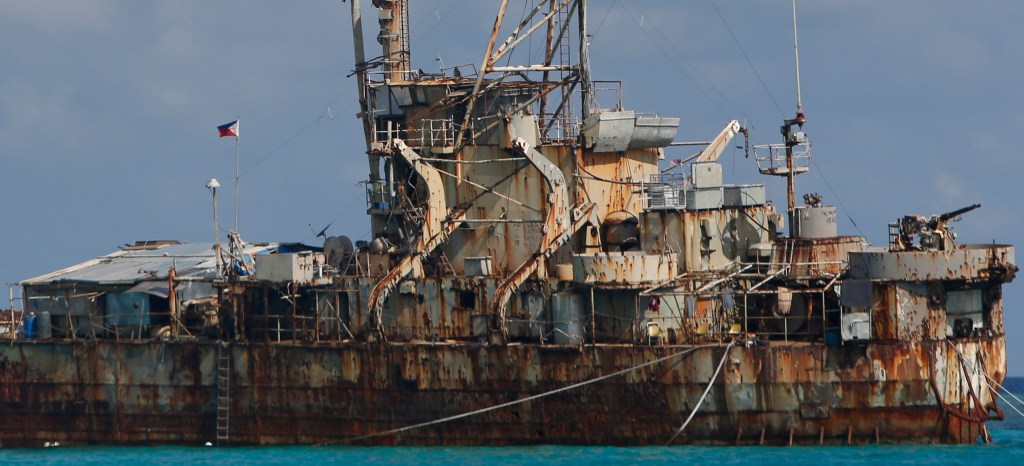
A rusting amphibious landing craft in Ayungin Shoal, internationally known as Second Thomas Shoal, has emerged as a fresh flashpoint in the contested South China Sea. The decommissioned BRP Sierra Madre has provided the Philippines with a presence in the low-tide feature since 1999. But China’s decision to disrupt a routine resupply run for Filipino troops stationed on the ship stirred a new tempest between the two neighbors.
In early August, China’s Coast Guard used its vessels’ size and water cannons to physically block and prevent two Philippine civilian boats carrying supplies bound for Ayungin. The boats were chartered by the Philippine Navy and escorted by the Philippine Coast Guard. In the past, reports of interference in such normal resupply sorties were far and between. China protested the deliberate grounding of the ex-US Navy landing ship tank and offered to tow it, but Manila did not budge. Since then, it has served as the country’s makeshift outpost in the area. But as the decrepit hull is now seriously exposed to the elements, Manila is taking steps to reinforce it and improve its habitability for Filipino marines holed up in the crumbling platform. China is likely concerned about this move and wary that its neighbor is bringing construction materials in those supply runs.
There is no denying that Beijing’s goal is to let the elements do their course on the ship, which Manila would not allow. China may also be upping the pressure on Ayungin to signal its disapproval of Manila’s move to align with the United States, notably by granting military access to four additional sites across the country. This includes one in Palawan facing the South China Sea and three in northern Luzon facing Taiwan. Philippine efforts to bring media to join its supply missions and expose Chinese belligerence may have also incensed Beijing. China responded in a way that shows such a move will not deter it.
Manila’s tell-all approach may have initially surprised Beijing, who may have thought that the Marcos government will handle maritime disputes discreetly through dialogue and diplomacy like its predecessor. Whether the deterrent value of this approach is sustainable or will eventually wear off, only later events can tell. For sure, the Chinese leadership does not want to be seen as backing down from open and publicized “infringements” on its claimed waters or features. This will not look well for its domestic audience, the party, and the army. Beijing may signal to Manila that it wants the issue to be resolved through bilateral or regional mechanisms, excluding what it sees as unwanted involvement by non-claimants. To this end, it will likely rachet up the pressure on Manila to drive this point.
The name-and-shame strategy is likely to strain bilateral ties. Aside from increased pressure in the West Philippine Sea through gray zone actions that Beijing has perfected, China may also pull economic strings. The goal is to “teach” its neighbor a lesson, hope it will come to its “senses” and warn other disputants not to follow its example. On Manila’s part, it may amplify the noise, step up patrols and up engagement with allies and partners to demonstrate its resolve, and impose more reputational costs on China. The view is that such measures may strengthens the country’s hand in any talks to resolve the debacle. The goal is to prevent the recurrence of untoward sea incidents and dissuade Chinese disruption of Philippine economic activities in its maritime zones and regular supply dispatch to its outposts in the Kalayaan (Spratlys). The hope is that the tell-all is just a means and not an end unto itself.
Some quarters in the Philippines are frustrated that the government has taken too long to make its position in Ayungin more permanent. They further question the overly cautious attitude that seeks to avoid antagonizing Beijing and other neighboring claimants.They point to China reneging on its earlier commitment to keep the structures built in another contested feature, the Panganiban (Mischief) Reef, in 1994-95 as fishermen’s shelters only. By 1999, more structures unrelated to fishing, were added. Between 2014 to 2016, while an arbitration case was ongoing, the atoll got a game-changing facelift, becaming a key part of China’s Great Wall of Sand. Some may think that this should offer a template for Manila to create a permanent presence in Ayungin. China did not keep its word. Why then should the Philippines be expected to do so?
For the time being, the Philippines will likely persist in delivering construction materials in its routine resupply to Ayungin. Delays or attempts to accommodate Chinese objections over this shipment may be seen as succumbing to Chinese demands – undercutting Marcos’ public standing. Manila will likely downplay the fact that Beijing allows the flow of essential supplies like food, water, and other provisions out of humanitarian consideration, and play up that Beijing is obstructing what is supposed to be a regular supply run. Moreover, the Philippines may point out that this has long been the arrangement – that it brings supplies to its troops in Ayungin and construction materials are part of it – and China is attempting to alter this status quo by blocking their passage now.
Given the deteriorating state of BRP Sierra Madre, the current situation is unsustainable and a new path must soon be forged. The stakes are high. If the marooned ship is swallowed by the sea, it will remove Manila’s marker in the shoal. President Marcos Jr. has two options: 1) find ways to extend the carrying capacity of the ship and let his successor deal with its eroding state in the future or; 2) establish permanent structures in Ayungin outside the ship. If he goes for the second, he will cement a strong legacy similar to what his father did when Ferdinand Sr. first staked out the country’s claims in the strategic resource-rich sea in the 1970s. Whether the son can pull it off and how China would react bears watching.
Lucio Blanco Pitlo III is a Taiwan Fellow and Visiting Scholar at the Department of Diplomacy and Center for Foreign Policy Studies of the National Chengchi University.
 Taiwan Center for Security Studies