
TCSS Security Commentaries #035
india’s g20 presidency, peaking with the recent leaders summit and the outcomes that came with it, produced a moment of reckoning for India, placing it in a leveraged position vis-à-vis its domestic and international aspirations.
K. Mansi (PhD), MOFA Fellow, TCSS.
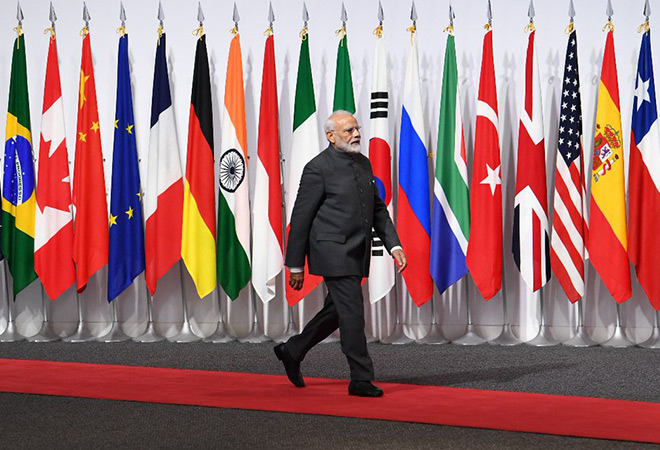
The 18th edition of the Group of Twenty (G-20) summit mega event, held in New Delhi over the 9th and 10th of September, saw the international gaze focus on India. Under the theme of ‘Vasudhaiva Kutumbakam’ or ‘One Earth, One Family, One Future’, India hosted more than 200 G20 meetings across the country including in the state of Jammu and Kashmir, and Arunachal Pradesh – an affirmation of its sovereignty and territorial integrity. Hailed as a diplomatic success, India’s G-20 presidency seems to have further consolidated its global image as both a prominent global power and a bridge between an ever widening North-South and East-West divide. This is demonstrated by the diplomatic coup that saw India manage find common interests between the competing blocs – the “western” G-7-EU axis and the Russia-China partnership – to produce a joint declaration, the New Delhi Declaration, with 100% consensus on all 83 paragraphs – six of which were dedicated to the geopolitics and the war in Ukraine. The summit’s achievements also include formally welcoming the 55 nation African Union to be the groups 21st member, and reaching agreement on an intercontinental economic corridor that will link India, the Middle East and Europe through reviving the ‘spice route’. The absence of Russian President Vladmir Putin and Chinese President Xi, making Xi the first Chinese leader to miss the event since its inception, loomed large over the success of the G-20 leadership summit. However, the event and its outcomes produced a moment of reckoning for India, placing it in a leveraged position vis-à-vis its domestic and international aspirations.
The Geopolitical Underpinnings:
While the G-20 is hailed as the premier global forum for international economic cooperation, and not the platform to resolve geopolitical and security issues, the decisions taken, and announcements made at the side lines of the G-20 have strong geopolitical implications – the most significant of which was a blueprint for the aforementioned new economic corridor.
IMEC: Spice Route vs Silk Route
The ambitious India-Middle East-Europe corridor (IMEC) – a move seen as a counterweight to China’s ‘belt and road’ initiative – is envisioned as a network of railways and sea lanes of transportation to connect the West cost of India to five ‘short listed’ ports in West Asia – in the UAE and Saudi Arabia – to European ports in Greece, Italy, and France. Several options are being explored and a study has already been conducted to identify the missing links in both the already existing and under-construction railway lines in the Middle East. This project is also viewed as a revival of an ancient ‘spice route’ which existed even before the ‘silk route’ – which China has been trying to revive since last decade with its Belt and Road Initiative.
With this project, which forms a part of the Partnership for Global Infrastructure and Investment (PGII), the US led West is trying to challenge Chinese economic clout in the region by offering an alternative partner. This is also an effort to counter the claim that US power is declining in the region, a view which has increased in prominence after Biden pulled out American troops from Afghanistan in 2021. The US is also trying to reset its relations with Saudi Arabia amid changing Middle Eastern dynamics. As its traditional partners in the region are deepening their ties with China, India, and other Asian powers, the US needs to actively step up its engagement to safeguard its interests there.
For India, this corridor is economically and strategically beneficial. India seems to benefit from the growing US-China rift and is happy to piggyback on the West for an access to Central Asia that circumvents Pakistan and Afghanistan. India can also leverage integration of the route when in deliberations with the South Asian economies. Furthermore, it provides an opportunity to combine investment in transport infrastructure with that of the industrial base which is anchored in manufacturing value chains. In so doing, it will allow India to realise its potential of becoming a true Eurasian economic power. Finally, this route provides an alternative to the Chabahar-based North-South Transit Corridor and it would serve as an Indian ocean connectivity node, making trade between India and Europe 40% faster.
Whilst this appears great on paper, the main question for the proponents of the plan to answer is: where the investment will come from? Given the ambition this project has it will take some time before this becomes clear. But until there is clarity around this, it remains simply an idea on paper.
In sum, it may be inferred that the summit it was not just India’s diplomatic success but also a much-needed success for the West. With the rift between the US-led West and the China-Russia dyad widening, and the relations between India and China also at their nadir, China appears more comfortable in groupings like SCO and BRICS where it enjoys greater power and influence. Hence, it was imperative for the West to push India, which is seen a potential bulwark against China, to gain successful outcomes at the conclusion of the summit. For India, it’s a huge success for its brand of diplomacy of the India Way which will figure prominently in the general elections due next year.
K. Mansi (PhD) is a Ministry of Foreign Affairs Fellow, a Visiting Scholar at TCSS and an Assistant Professor at Amity University Haryana, India.
 Taiwan Center for Security Studies