
TCSS Security Commentaries #034
As ASEAN countries seek to develop their domestic industry to capture more of the value-chain, Taiwan can build on its established links with the region to leverage its dominance in the semi-conductor supply chain to gain more, much needed, diplomatic support.
Lucio Blanco Pitlo III, Taiwan Fellow and Visiting Scholar, NCCU.
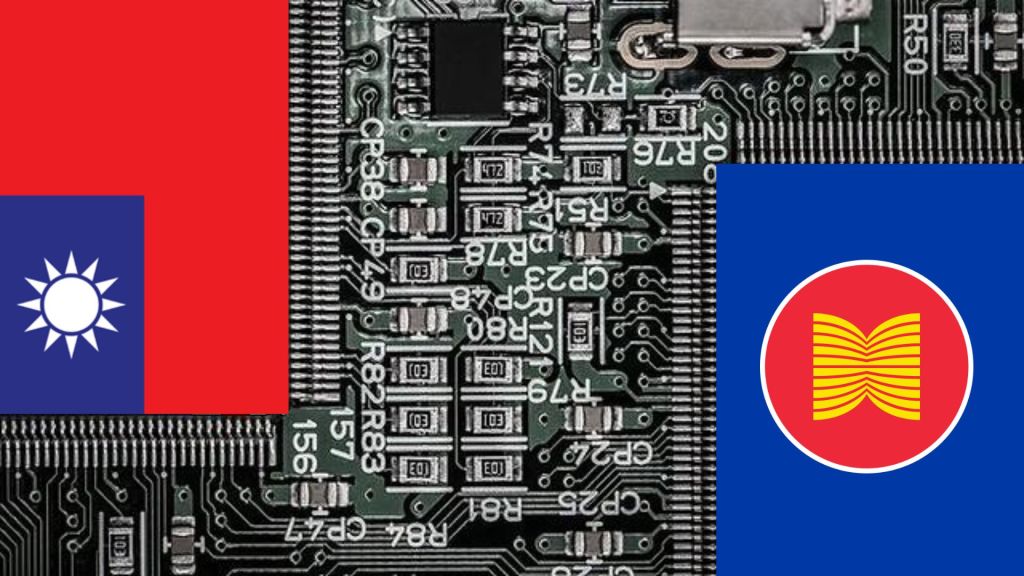
As ASEAN countries seek to develop their domestic industry to capture more of the value-chain, Taiwan can build on its established links with the region to leverage its dominance in the semi-conductor supply chain to gain more, much needed, diplomatic support.
About 720,000 migrant workers from Southeast Asia helped make Taiwan the world’s largest chipmaker. Their presence provides a human face to strong ties between Taipei and Southeast Asia underpinned by burgeoning trade, capital, and people-to-people flows. This makes the region invested in the security of the democratic island and stability in cross-Strait ties.
As tensions simmer across the Taiwan Strait, countries like Indonesia and the Philippines bared plans to repatriate their nationals should conditions demand the same. But ASEAN countries can do more than draw up exit measures for their citizens and issue statements expressing serious concern about disturbing developments in the hotspot. Extending Taiwan’s Silicon Shield to Southeast Asia will bolster Taipei’s appeal in its immediate backyard and prod regional countries to exert greater diplomacy to arrest a worrying spiral.
Taiwan matters to Southeast Asia and vice versa. As of June 2023, 259,558 Indonesians, 259,088 Vietnamese, 152,529 Filipinos, and 68, 318 Thais are working on the island. Taiwan is also ASEAN’s ninth-largest export market, sixth-largest import source, and ninth-largest investor. In turn, ASEAN, was Taiwan’s second-largest export market after the Mainland and Hong Kong and third-largest import source behind the Mainland and Japan. Three of the island’s top 10 largest trade partners are from the region – Singapore (6th), Malaysia (8th), and Vietnam (9th).
ASEAN is also emerging as the top destination for Taiwan’s outbound capital, cornering $4 billion or 32 percent of all outward investments last year. Four of the top ten leading countries in terms of attracting Taiwanese FDI are from the region – Singapore (1st), Vietnam (4th), Indonesia (7th), and Thailand (8th). It is no surprise then, that ASEAN is at the heart of the New Southbound Policy.
One facet of Taiwan-ASEAN partnership that can be further deepened with implications for the island’s security lies in the semiconductor industry. ASEAN is likely to gain as Taiwanese capital diminishes reliance or diversifies away from the Mainland. This process has already begun, and de-risking will increase its momentum.
Risks associated with the heavy concentration of advanced chipmaking capacity on the island raise the salience of dispersal. Proximity, production cost, and markets make Southeast Asia a good bet for nearshoring or friendshoring. None expect Taipei to part with its core technologies and expertise, but relocating some of its less sensitive tech production to neighboring countries may reap economic and security payoffs. Taiwanese tech investments in the region can alleviate exposure on the mainland, contribute to global supply chain resilience, and provide Taipei leverage in its relations with its southern neighbors.
Taiwan is gradually flexing its chip muscle, delivering tech investments to countries stepping up to support it. TSMC is putting up wafer fabs in Arizona (US) and Kumamoto (Japan). A possible TSMC foundry in Veneto was also dangled in Italy to get a new representative office in Milan. Taiwan can also exercise chip diplomacy in its immediate neighborhood. For fast-developing countries eager to climb up the value chain, solid investments from a tech powerhouse like Taiwan will be attractive.
Taipei may seek ASEAN’s help to participate in the evolving regional trade and economic architecture, including its bid to join the Comprehensive and Progressive Trans-Pacific Partnership. It is one thing for Japan and Canada to endorse Taipei’s application. It is another if Singapore, Vietnam, and Malaysia also welcome the idea. Singapore is the only ASEAN country and one of only four Indo-Pacific economies with a free trade agreement with Taiwan. Support from such a global trade and investment hub can buoy the prospects for Taipei.
Taiwan has been a member of Asia-Pacific Economic Cooperation since 1991, and it can build on this foundation to have a seat on the table in upgrading regional if not global economic configurations. As San Francisco hosts this year’s APEC Summit, Taiwan may seek the aid of the United States and other partners to grow its international economic engagement, including possible participation in the Indo-Pacific Economic Framework. Seeing the island play a meaningful and positive role in the region’s economy may be seen as less political than hosting new representative missions or renaming them.
More than pushing back against efforts to diminish its global space, “chips for diplomacy” can be harnessed by Taipei to persuade ASEAN to be more proactive on cross-Strait issues. Countries in the region are no strangers to providing venues for disputants to talk. In 2015, Singapore hosted the first cross-Strait dialogue since the end of the Civil War. In 2018 and 2019, Singapore and Hanoi respectively hosted meetings between the US and North Korea. While these summits may be more symbolic than substantive, and no breakthroughs were reached, they helped lower the temperature in the region’s flashpoints. They, too, showed openness among opposing parties to sit down and hold exchanges. This year’s ASEAN rotating chair, Indonesia, can take off from this track record to position the bloc to play a part in defusing tensions. Taiwan can play to its strengths to pursue economic and security goals. Expanding the Silicon Shield to Southeast Asia can activate crucial neighbors that can play valuable roles in keeping cross-Strait peace.
Lucio Blanco Pitlo III is a Taiwan Fellow and Visiting Scholar at the Department of Diplomacy and Center for Foreign Policy Studies of the National Chengchi University.
 Taiwan Center for Security Studies