
TCSS Security Commentaries #034
An excess of partnerships could potentially lead to a strategic shift by China, forging deeper divisions in the region. As Japan moves towards closer ties with Western countries, it’s a dynamic situation that requires mindful handling from all parties involved.
Pauline Geyer, Intern, TCSS.
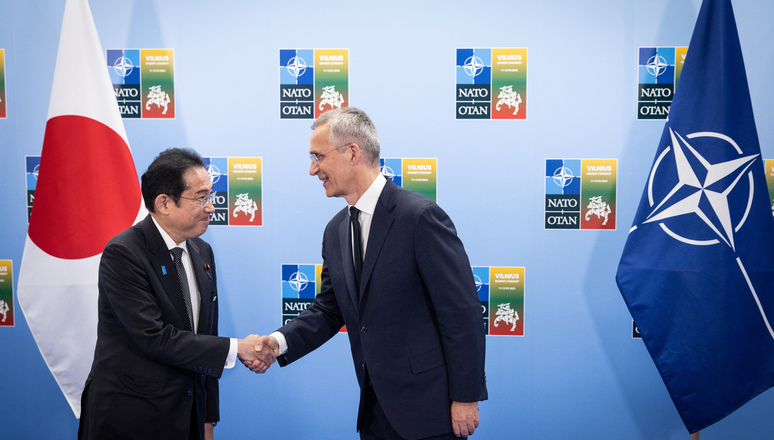
“Any act that jeopardises China’s legitimate rights and interests will be met with a resolute response.” This warning, from the Chinese Mission to the European Union, comes in response to NATO’s lean into the Indo-Pacific on display through criticisms of China at the NATO 2023 Vilnius summit and the recently agreed to Individual Tailored Partnership Programmes (ITPP) between NATO and the so called ‘Indo-Pacific 4’ (IP4) – consisting of Japan, South Korea, Australia and New Zealand.
In July 2023 the capital of Lithuania hosted the 2023 NATO summit. The summit marked a historic event in the alliance’s history, NATO Secretary General Stoltenberg said. Notably, the summit saw the formation of the most comprehensive and resilient defense plans since of the Cold War era. Its outcomes included the adaption of Regional Plans, agreement on a support package for Ukraine, a new investment pledge, the welcoming of new allies, and agreeing to more extensive cooperation with partners.
For the second time, following their attendance at the Madrid summit in 2022, the IP4 participated in the summit. This expansion of the role of partnerships aligns with the alliance’s intention to use collaboration as a tool to expand its agency to respond to perceived threats.
The Indo-Pacific region holds a significant role within NATO’s strategic considerations due to the potential ramifications for its own security. For the first time, NATO acknowledged China as a security challenge in its 2022 new strategic concept. Then, at the 2023 NATO summit in Vilnius, this conception was reaffirmed through criticisms directed towards China and North Korea in its Vilnius Summit Communiqué.
In the realm of geopolitics, China stands out for its proclaimed aspirations and assertive actions that cast a shadow on the existing regional order and international institutions. This has caught the eye of NATO member-states who are increasingly concerned about these systemic challenges. It’s worth noting that in this regard, various threats, including those in the realms of cyber, space, and hybrid warfare, have emerged as pressing concerns for NATO. China’s activities in these domains, coupled with its use of confrontational rhetoric and disinformation tactics, have been targeted at NATO Allies. Of particular concern for NATO is China’s strategic intent to exert influence and control over pivotal technological and industrial sectors, critical infrastructure, and global supply chains. Additionally, the strengthening strategic partnership between China and Russia is concerning to NATO as it has the potential to undermine the alliance’s values and interests.
In response to these perceived threats China presents, NATO has sought to widen its influence in the Indo-Pacific region. To further address shared security challenges, NATO aims to fortify its dialogue and collaborative efforts with Indo-Pacific partners. At the 2023 Vilnius summit NATO Secretary General Stoltenberg said that no partner worldwide is closer to NATO than Japan. With its proximity to China, democratic and rule-based values and important role in trade, Japan serves as a long-lasting partner.
For a deepened partnership, Japan and NATO both welcomed their ITPP which is centred around three strategic objectives for the period from 2023 to 2026. First, NATO and Japan want to strengthen dialogue and consultations. Second, by collaborating on areas like cyber defense, technology, space and maritime security the partners want to enhance global peace and stability. Third, with the program, NATO and Japan want to enhance individual resilience and promote practical cooperation and interoperability in areas such as emergency management, defense innovation and more. The collaboration spans 16 goals, promoting security in emerging and longstanding issues, expanding cooperative activities, and upholding fundamental values such as women, peace, and security. This partnership reflects a commitment to shared values in an increasingly complex world and hints at forthcoming cooperation with Japan and both the EU and NATO.
While this collaboration could enhance stability in the Indo-Pacific, NATO and Japan must tread cautiously. China has a distinct tradition of opposing Western – particularly military – influence in the region. In line with this, it has warned NATO of consequences for expanding into ‘its’ region. Moreover, China has expressed the view that there are risks for Japan and the entire Indo-Pacific region stemming from closer ties with NATO.
China’s criticism of NATO’s eastward movement, paired with the evolving partnership program, underscores the need for careful navigation. NATO needs to take China’s warning into account while cooperating with Indo-Pacific partners as an excess of influence could lead to a strategic shift by China, possibly involving other countries in the region. As Japan moves towards closer ties with Western countries, it’s a dynamic situation that requires mindful handling from all parties involved.
Pauline Geyer is an undergraduate pursuing International Relations and Social Science from the University of Erfurt, Germany. She specializes in global security and public international law. She is an exchange student at the Department of Political Science at National Chengchi University and an Intern at TCSS.
 Taiwan Center for Security Studies