
TCSS Security Commentaries #034
The recent BRICS summit assumes heightened geopolitical significance and solidifies China’s leadership role within the bloc. The inclusion of six new members, notably encompassing significant Arab nations with abundant energy resources, especially Saudi Arabia and the United Arab Emirates, marks a distinct shift away from the traditional sphere of American influence.
Italo Queiroz, Intern, TCSS.
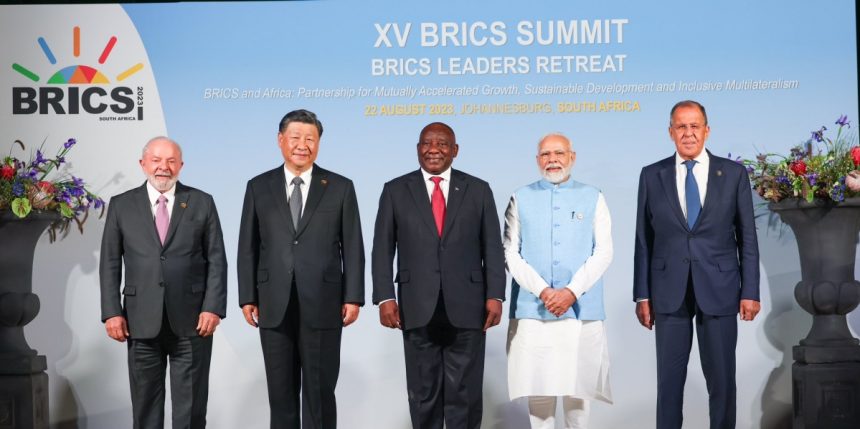
From August 22nd to 24th, the leaders of BRICS convened in Johannesburg, South Africa for deliberations on a range of topics including, among others, the creation of a common currency and the ongoing conflict in Ukraine. The issue that dominated the discussions, however, is what course enlargement of the bloc should track.
Since the start of 2023, a remarkable surge of over 40 nations have expressed keen interest in seeking BRICS membership. Notable entrants on this list included Iran, Saudi Arabia, the United Arab Emirates, Argentina, Bolivia, Indonesia, Egypt, Ethiopia, Cuba, the Democratic Republic of Congo. Despite spanning several geographies, a prevailing commonality among these aspirants is their shared discontentment with the still Western-centric global and financial order. To this point, these countries view BRICS as a viable alternative to the existing frameworks. A pivotal factor influencing this outlook is the presence of the New Development Bank, also known as the BRICS Bank. This establishment stands as a modest counterforce to the influence wielded by the IMF and World Bank, lending further credence to the idea of BRICS as an alternative option on the global stage and the possible voice of the global south.
Both Russia and China were profoundly invested in the prospect of extending the BRICS. Against the backdrop of the ongoing conflict in Ukraine and the consequential sanctions imposed on Russia, the Kremlin sees the Bloc as a promising avenue to augment trade relations with developing nations, thereby mitigating the adverse ramifications of economic sanctions. In parallel, China envisions the bloc not only as an avenue to confront the dominion of American influence but also as a strategic opportunity to amplify its sway over emerging economies. This is in line with the now established trend of China’s international engagement which sees it actively committed to shaping a new paradigm of global governance.
In the early days of August, the Russian Government voiced the perspective that broadening the bloc’s membership could enhance its collective strength, a response to Brazilian President Luis Inacio Lula da Silva’s advocacy for the inclusion of Saudi Arabia, Argentina, and the United Arab Emirates in BRICS.
However, Brazil and India exhibited a degree of caution concerning the swift enlargement of the bloc. Both countries share amicable relations with the United States and Europe, thus seek to avert the emergence of an antagonistic bloc in opposition to Western interests.
Despite the aforementioned stance articulated by the Brazilian head of state, the nation’s diplomatic circles hold reservations concerning the expansion. From its perspective, increasing the member states may cause Brazil to experience a decline in its influence and position of prominence within the bloc. Moreover, Brazil seeks to support the accession of countries that align with the pursuit of reforms within international institutions, particularly the United Nations and its Security Council. In this context, Brazil has voiced the expectation that prospective members would actively endorse these reform efforts. Brazil also seeks China’s official support for its bid to secure a permanent seat on the Security Council.
India shared Brazil’s concern that it will lose prominence within the bloc as the addition of certain member countries could see it become even more dominated by Beijing. Furthermore, India is faces a complex geopolitical landscape, coupled with India’s recent experience of territorial disputes with China. This has led India to re-emphasize close ties with the US and Europe.
Notwithstanding these reservations, it is evident Brazil and India have demonstrated flexibility in their stance. As long as applicants satisfy well-defined regulations and guidelines, the countries appear willing to continue BRICS expansion to encompass even more of the global south. It was expected their support will be thrown behind other democracies such as Indonesia, Argentina or Nigeria.
Both nations might adeptly navigate a balancing act between China on one hand and the United States and Europe on the other. Brazil can appeal to the west by strategically employing its environmental diplomacy to align with the west’s goal of global sustainability. India, however, can leverage its arms acquisition agreements with the United States.
At the close of the summit, the bloc had six new members: Argentina, Iran, Egypt, Saudi Arabia, Ethiopia, and the United Arab Emirates. The final declaration of the BRICS summit of 2023 mentioned that the countries had reached a consensus on the expansion “true to the BRICS Spirit and commitment to inclusive multilateralism, BRICS countries reached consensus on the guiding principles, standards, criteria and procedures of the BRICS expansion process.” This, however, demonstrates persisting divisions as it does not specify which criteria were adopted. Instead, the decision appears to have been influenced by factors such as population size, GDP, geographical location, and availability of energy resources.
Brazil relinquished some of its influence within the group, with the expectation of a future reforms and permanent seat in the UN Security Council, bolstered by Chinese support. However, it is uncertain whether Beijing will extend its support to the G4 – Brazil, India, Japan, and Germany – given that it contends two of its geopolitical competitors.
The expansion witnessed China emerging as the significant beneficiary, especially with the inclusion of Saudi Arabia and the United Arab Emirates. This development seamlessly integrates these energy-rich nations into China’s realm of influence, notably due to their vast reserves of oil and natural gas. Iran’s entry into the bloc, backed staunchly by Russia, not only underscores a united front between large powers antithetical to the US, but also means that Iran is no longer isolated.
The inclusion of Egypt and Ethiopia, on the other hand, is attributed more to their population size, GDP, and strategic geographic positioning. Brazil demonstrated remarkable effort in securing Argentina’s, a country grappling with an economic crisis, accession. Being a democratic nation with robust economic ties to Brazil, China, and India helped. But in addition to reinforcing existing relationships, Argentina’s membership can also serve as a blueprint of potential future financial assistance through its BRICS and the New development bank membership.
Despite BRICS members holding diverse perspectives on whether the group should position itself as an anti-West organization, they are united by a common sentiment of dissatisfaction with the current state of global governance and international financial institutions. This shared discontentment serves as a cohesive element. The convening of the BRICS summit in 2023 marks a significant transformation, shifting the group’s identity from solely a geo-economic force to a more pronounced geo -political and -strategic grouping.
Italo Matos de Queiroz is an undergraduate student at Ming Chuan University, where he majors in International Affairs and Diplomacy and an intern at TCSS.
 Taiwan Center for Security Studies