
TCSS Security Commentaries #033
nato’s lean to the indo-pacific – led by its engagement with the ‘ap4’ australia, new zealand, japan and south korea – and its stated concerns over china’s intentions and behaviour are significant developments in the dynamics of international security.
-Georg Tannen, Intern, TCSS
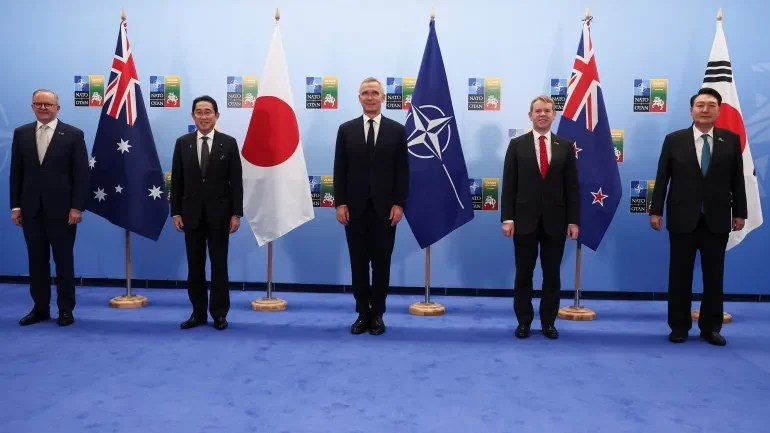
Recently, from 12 to 23 June this year, NATO has conducted the largest operational exercise of air forces in its history under the command of the German Air Force. 25 nations with 250 aircraft took part in the exercise Air Defender 23 which trained air operations in European airspace. Surprisingly, one of the countries participating in this exercise was Japan. At the same time, NATO is also preparing new bilateral cooperation documents, a so-called Individually Tailored Partnership Program (ITPP), with the Asia-Pacific partners, the so-called AP4: Australia, Japan, the Republic of Korea, and New Zealand. However, the NATO Secretary General warned as early as January this year during a visit with Japan’s Prime Minister Fumio Kishida, as follows: “What is happening in Europe today could happen in East Asia tomorrow. So we must remain united and firm. Standing together for freedom and democracy.” Stoltenberg affirmed NATO’s support for Japan’s vision of a free and open Indo-Pacific and pointed out that China’s behavior was a matter of serious concern. As such, these current developments open up the discussion on NATO’s cooperation with the Indo-Pacific region in general.
NATO has 39 different partnerships with non-member states in regional frameworks as well as on a bilateral level. Since 1994, NATO has developed relations in a regional framework with the Euro-Atlantic Partnership through the Euro-Atlantic Partnership Council and the Partnership for Peace, as well as the Mediterranean Partnership through the Mediterranean Dialogue. Later in 2004, the Alliance enhanced its relations with the Gulf region through the Istanbul Cooperation Initiative. The NATO 2010 Strategic Concept highlights the concept of an open format of 31+n by promoting the idea that “Euro-Atlantic security is best assured through a wide network of partner relationships with countries and organizations around the globe”. In the strategy, the idea of establishing security through partnerships is conceived in the concept of cooperative security, which is mentioned as one of the three pillars of NATO’s core task. Since then, NATO has deepened its bilateral relations with 9 non-member countries around the world over the years, the AP4 being four of them. The idea of cooperative security is reaffirmed by the follow-up strategy of the NATO 2022 Strategic Concept.
In the past, NATO and the AP4 have developed Individual Partnership Cooperation Programmes on a variety of issues such as cyber, technology, resilience, arms control, maritime security and climate change. Aside from these bilateral collaborations, NATO has increased its political engagement with AP4, particularly through North Atlantic Council meetings, since 2016. The relevant AP4 ministers have been regularly invited to NATO ministerial meetings since 2020, in particular to discuss the shift in the global balance of power and the rise of China. The rapprochement between NATO and AP4 is driven by a mutual concern about China undermining the rules-based international order and future conflicts in the Indo-Pacific region.
NATO’s current approach to the Indo-Pacific is guided by NATO Agenda 2030 and the NATO 2022 Strategic Concept. The 2030 Agenda outlines a complex security environment, pointing to the premise that global challenges require global solutions, so cooperation with like-minded partners around the world are essential to solve future issues. The agenda also takes into account the shift in the global balance of power and the rise of China, which necessitate closer dialogue with China as well as with all relevant actors in the Indo-Pacific region. With the 2022 Strategic Concept identifying China as an actor who challenges the rules-based international order with a broad range of political, economic and military means, which implies that China is a strategic competitor, as stated in a general report of the NATO Parliamentary Assembly’s Political Committee. Furthermore, the Strategic Concept 2022 recognizes the link between the Indo-Pacific region and Euro-Atlantic security and emphasizes the significance of future cooperation with actors in the region.
However, a divergence of opinion has appeared surrounding the extent to which NATO should involve itself in Indo-Pacific affairs. In order to ensure security for actors in the Indo-Pacific, a proposal was made by Ian Easton, the Senior Director of Project 2049, to create a new greater regional alliance similar to NATO. However, given any mention of the Tokyo liaison office was excluded in the joint communique of this year’s NATO summit in Vilnius, it appears that French President Macron’s warning that it would be a ‘big mistake’ to broaden the ‘spectrum and the geography’ of the alliance has been heeded, at least for now.
Despite this, dialogue and cooperation between NATO and the AP4 was necessarily strengthened in the Vilnius summit. All four heads of state were in attendance, and all reaffirmed their commitment to engaging with NATO on matters of global and regional security. It remains unclear how deep NATO-AP4 engagement will become, and whether more countries in the region will either seek to be involved in, or publicly oppose, its Indo-Pacific engagement. But as the interests of both NATO and AP4 are clearly aligned in preserving the Indo-Pacific’s regional order, it is right to say that we can expect further developments.
Georg Tannen is an undergraduate student at the University of Münster, Germany where he majors in political science and philosophy.
 Taiwan Center for Security Studies